

Mother touch toys
Wooden Stacking Ring Tower for Kids 3+ – Counting, Colours & Number Sequencing Toy
Wooden Stacking Ring Tower for Kids 3+ – Counting, Colours & Number Sequencing Toy
Couldn't load pickup availability
Wooden Stacking Ring Tower for Kids – Learn Through Hands-On Play
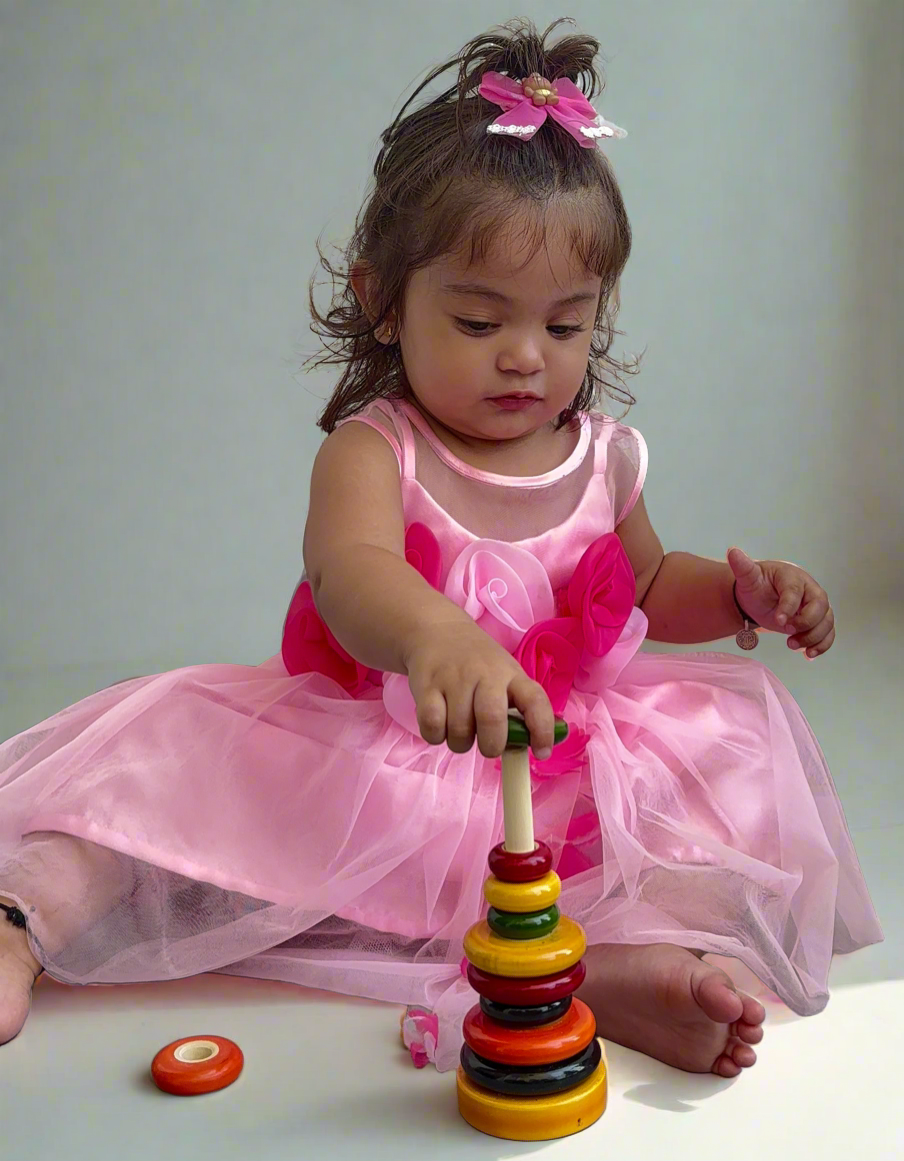
Turn early learning into an interactive activity with the Mother Touch Toys Wooden Stacking Ring Tower, designed for children 3 years and above.
This colourful wooden learning toy combines stacking, counting, colour recognition and number sequencing in one hands-on activity. Children can pick up the rings, place them on the tower and experiment with different sequences while learning basic concepts through play.
Wooden ring stackers are commonly used for hands-on learning because stacking and sorting can support early number concepts, colour recognition, fine motor development and hand-eye coordination.
Stack the Rings and Build the Tower
The main activity is simple: pick up the wooden rings and stack them onto the tower.
As children repeatedly lift, position and place each ring, they practise controlling their hand movements while watching how the tower changes as more rings are added.
The growing tower also gives children a visible result of their activity, making learning more engaging.
Learn Colours While Playing
The colourful rings provide an easy opportunity to introduce colour recognition.
Parents and teachers can ask children to:
- Name each colour
- Find a particular colour
- Group rings by colour
- Count rings of a specific colour
- Create their own colour sequence
This transforms a simple stacking activity into a fun preschool learning exercise.
Practise Counting With Real Objects
Counting becomes more meaningful when children can physically move the objects they are counting.
Ask your child to place the rings one at a time while counting aloud:
1 → 2 → 3 → 4 → 5
Children can repeat the activity while touching and moving each ring, helping them connect number words with actual objects.
Understand Ascending & Descending Order
The stacking rings can also be used to introduce the idea of number order.
Start with a simple ascending sequence:
1 → 2 → 3 → 4 → 5
Then reverse the activity:
5 → 4 → 3 → 2 → 1
Parents can gradually make the activity more challenging by asking children to identify what number comes before or after another number.
Explore Sequencing Through Stacking
Sequencing is an important early-learning concept. Children can create patterns by arranging rings according to colour, size or number, depending on the design of your particular set.
The activity encourages children to notice what comes next and think about how objects can be organised in a particular order.
Supports Early Fine Motor Development
Picking up and placing individual rings requires children to coordinate their fingers, hands and eyes.
Stacking activities can provide opportunities to practise:
- Grasping
- Releasing
- Positioning
- Hand control
- Hand-eye coordination
Similar wooden ring-stacking products are positioned as activities for fine motor skills, coordination and concentration.
Educational Benefits
🔢 Counting Practice
Children can count the rings while placing them onto the tower.
🌈 Colour Recognition
Colourful rings provide opportunities to identify, compare and sort colours.
📚 Number Sequencing
The activity can introduce ascending and descending number sequences.
🧠 Early Logical Thinking
Children can experiment with different ways to organise and sequence the rings.
✋ Fine Motor Skills
Picking up and positioning individual rings encourages controlled hand movements.
👀 Hand-Eye Coordination
Children coordinate their visual attention with their hands while stacking.
🎯 Concentration
Completing the tower encourages children to remain focused on the activity.
🔄 Sequencing Skills
Repeated patterns and ordered arrangements help introduce the concept of sequence.
📵 Screen-Free Learning
Provides a hands-on learning activity without requiring electronic devices.
Fun Learning Activities for Parents & Teachers
The Wooden Stacking Ring Tower can be used in several ways rather than only stacking the rings.
Activity 1 – Count the Rings
Ask your child to count each ring as they place it on the tower.
Activity 2 – Name the Colours
Ask the child to identify the colour of each ring.
Activity 3 – Ascending Order
Arrange or discuss numbers from the smallest to the largest.
Activity 4 – Descending Order
Reverse the sequence and practise counting backwards.
Activity 5 – Colour Sequence
Create a simple colour pattern and ask the child to repeat it.
Activity 6 – What's Missing?
Remove one ring and ask the child to identify what has changed.
These activities allow parents to gradually increase the learning challenge as the child becomes more comfortable with the toy.
A Wooden Preschool Learning Toy
The Wooden Stacking Ring Tower for Kids is suitable for home learning, preschool classrooms, activity centres and early-learning sessions.
Its simple design allows children to learn through doing rather than only listening or watching. The combination of colourful rings and physical stacking makes it an engaging way to introduce foundational concepts in early maths, colours and sequencing.
Product Details
- Product Type: Wooden Stacking Ring Tower
- Recommended Age: 3+ Years
- Material: Wood
- Learning Areas: Counting, Colours & Number Sequencing
- Activity: Stacking, Sorting & Ordering
- Suitable For: Preschool & Home Learning
- Brand: Mother Touch Toys
Add the exact number of rings, dimensions and weight according to your actual product.
How to Play
- Place the wooden tower on a stable surface.
- Take the rings off the tower.
- Ask the child to identify their colours.
- Count the rings together.
- Let the child place the rings onto the tower.
- Practise simple ascending and descending number sequences.
- Create colour or number patterns for an additional challenge.
- Repeat the activity and allow the child to experiment independently.
Share