Puzzle Difficulty Guide: Choosing the Right Puzzle for Kids
1. How do I choose a puzzle based on my child's age?
Choose a puzzle according to your child's age, attention span, hand skills and experience with puzzles. Younger children can start with simple large-piece puzzles, matching activities and shape boards. As children become more confident, introduce interlocking, logic, string and brain teaser puzzles with increasing difficulty. The goal is to provide a challenge without making the activity frustrating.
2. What is a good puzzle for beginners?
A good beginner puzzle should have simple rules, manageable pieces and an easy-to-understand objective. Wooden shape puzzles, matching puzzles, simple jigsaw puzzles and basic interlocking puzzles can be suitable starting points. Once a child understands how to approach puzzles, gradually introduce more challenging designs.
3. What are challenging puzzles for kids?
Challenging puzzles require children to think through multiple steps before finding a solution. Interlocking puzzles, logic puzzles, brain teasers, string or rope puzzles, and sequential movement puzzles can provide greater challenges. The right difficulty depends on the child's age and previous puzzle experience.
4. What are brain teaser puzzles for kids?
Brain teaser puzzles are activities that require children to think carefully, identify patterns, solve problems or discover an unexpected solution. They can include logic puzzles, interlocking puzzles, string puzzles, pattern challenges and other problem-solving activities. These puzzles encourage children to think beyond simple trial and error.
5. What are logic puzzles for kids?
Logic puzzles are puzzles that require children to use reasoning, observation, sequencing or problem-solving to reach a solution. They may involve arranging objects, identifying patterns, following a sequence or working out how different pieces connect. They can be introduced at different difficulty levels according to the child's age.
6. What are the best puzzles for problem-solving?
Puzzles that require children to plan, test different possibilities and adjust their approach can provide useful problem-solving practice. Interlocking puzzles, logic puzzles, brain teasers, string puzzles and construction-style puzzles are examples. The most suitable puzzle depends on the child's age, ability and experience.
7. What are interlocking puzzles for kids?
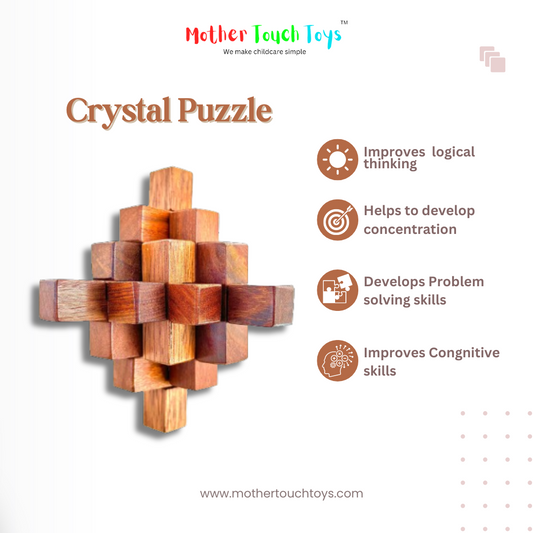
Interlocking puzzles are puzzles made from pieces that connect, fit or lock together in a particular way. Children need to observe the pieces, understand how they relate to one another and experiment with different arrangements. Wooden interlocking puzzles can provide hands-on opportunities to practise spatial reasoning and problem-solving.
8. What are string puzzles for kids?
String puzzles are puzzles that use a string, rope, ring or other connected components to create a challenge. The child usually needs to work out a sequence of movements to separate, move or reposition the pieces without cutting or damaging the string. They can be engaging brain teasers for children who enjoy hands-on challenges.
9. What are rope puzzles for kids?
Rope puzzles are a type of mechanical or brain teaser puzzle involving rope, rings, loops or wooden components. Children need to observe the structure and discover the correct sequence of movements to solve the challenge. Age suitability varies by design, so parents should check the manufacturer's recommended age before choosing one.
10. How can I make puzzles more challenging for children?
You can increase the challenge by choosing puzzles with more complex rules, multiple steps or less obvious solutions. Encourage children to solve the puzzle independently, ask them to explain their thinking, or introduce a more difficult puzzle after they become comfortable with an easier one. Avoid giving the solution immediately—allowing children time to experiment can make the activity more engaging.